
Author: Near Me Dental Team
We are a team of talented individuals that take creativity to a new level. We are not just another creative agency, we dream with you. We’re really passionate about our work and we love to turn visions into reality. Our goal is not only to satisfy our clients’ goals, but to exceed them in every way.
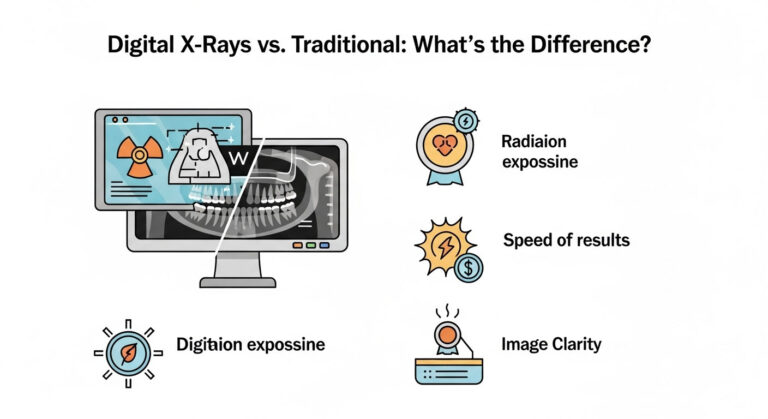
Your dentist says it’s time for X-rays, and you settle into the chair as the technician places a heavy lead apron over you. For years, this process involved biting down on an uncomfortable piece of film and waiting for it to be developed. But today, more and more dental offices are using a faster, more comfortable, and significantly safer alternative: digital X-rays. What’s the real difference between these modern dental technologies, and why does it matter for you as a patient? This guide will compare digital vs. traditional X-rays, highlighting the key advancements in digital dentistry.
What Are Traditional (Film) X-Rays?
Traditional X-rays use radiographic film, much like an old-school camera. An X-ray beam is passed through your teeth and gums, and the image is captured on a small piece of film placed inside your mouth. This film then has to be taken to a darkroom and developed using chemicals, a process that can take several minutes. Think of it as developing a photograph from a camera roll.
What Are Digital X-Rays? The New Standard in Dental Imaging
Digital X-rays replace film with a small, flat electronic sensor. This sensor is placed in your mouth, and when the X-ray is taken, the image is instantly sent to a computer screen. There is no chemical developing process and no waiting time. It’s the difference between taking a photo with a film camera versus your smartphone.
The Key Advantages of Digital X-Rays
The shift to digital dentistry isn’t just about convenience; it offers significant benefits in safety, quality, and efficiency.
- Up to 90% Less Radiation: This is the most important benefit. Digital sensors are far more sensitive than film, requiring significantly less radiation to capture a high-quality image. This makes them an exceptionally safe diagnostic tool.
- Instantaneous Images: The images appear on the computer screen within seconds. This means less time in the dental chair for you and allows your dentist to immediately review the results and discuss them with you.
- Superior Image Quality: Digital images can be enlarged, magnified, and adjusted for contrast and brightness, allowing your dentist to see tiny cavities or fractures that might be missed on a small film X-ray.
- Easy Sharing and Storage: Digital files can be easily and securely sent to specialists like an endodontist or oral surgeon for a consultation, improving collaboration and the quality of your care.
- Environmentally Friendly: Digital X-rays eliminate the need for the harsh chemicals used to develop traditional film, making them a greener choice.
The Consensus on Modern Dental Technology
The move toward digital X-rays is widely supported by dental health organizations. The American Dental Association (ADA) recognizes the significant reduction in radiation exposure as a key patient benefit. This advancement in modern dental technology allows dentists to get the diagnostic information they need while adhering to the ALARA principle (As Low As Reasonably Achievable) for radiation safety.
Finding a Modern Dental Practice
When you are choosing a new dentist, asking about the technology they use is a great way to gauge their commitment to modern, patient-centered care. A practice that has invested in digital X-rays is often one that prioritizes patient safety, efficiency, and accurate diagnoses. Whether you need a routine exam or a consultation with a cosmetic dentist for a smile makeover, modern imaging is a crucial part of the process.
Conclusion: A Clearer, Safer, and Faster Choice
In the digital vs. traditional X-ray comparison, the winner is clear. Digital X-rays offer a superior experience for both patient and dentist, providing higher quality images with a fraction of the radiation exposure. They are a prime example of how modern dental technology is making dental care safer, faster, and more effective than ever before. The next time you’re due for a check-up, you can feel confident knowing that the diagnostic tools being used are designed with your health and safety as the top priority.
Looking for a dentist who uses the latest technology? Use the Near Me Dental directory to find a top-rated, modern dental practice in your area.